You're about to make one of the larger purchases of your life for a product you've never bought before, judged by standards you've never heard of, for the most discerning customer you know. Deep breath. By the end of this chapter you'll know exactly what to buy and what to skip, and you'll likely spend less than the man next to you who knows none of it.
This chapter covers the whole road at overview speed. For the full course, decoding her exact style, the 4Cs in full, and the pitfalls that catch strong buyers, head into Ring School and take the Ring Masterclass.
The 4Cs, decoded
Every diamond on earth is priced by four measures: cut, color, clarity, and carat. Jewelers treat them as equally important. They're not. Knowing which ones to max out and which ones to relax is where the value hides.
Cut: never compromise
Cut determines how light moves through the stone, which means cut determines the sparkle. A well-cut diamond dazzles from across the room. A poorly cut one looks dull no matter what the certificate says about everything else.
Buy the best cut grade you can, ideally Excellent, before you spend a dollar anywhere else. A great cut hides minor color and clarity flaws. Nothing hides a bad cut.
Color: the G to H sweet spot
Color grades run from D, completely colorless, down to Z, visibly yellow. Here's the thing the pricing charts don't tell you: the difference between a D and a G is invisible to the naked eye and very visible on the receipt.
G to H grades look icy white to everyone she'll ever show the ring to, and they cost dramatically less than the D to F range. That gap is real money you can put into cut or carat.
Clarity: eye-clean is the standard
Clarity measures natural imperfections called inclusions. The goal is a stone that's eye-clean, meaning its flaws only show up under a jeweler's 10x loupe. She'll wear the ring on her hand, and nobody looks at it through a microscope.
VS2 or better is the value sweet spot. Paying for Flawless means paying for a certificate, not for anything anyone can see.
Carat: buy just shy of the magic sizes
Carat is weight, not size, and prices jump at the round numbers everyone asks for: 0.50, 1.00, 1.50, 2.00. The market calls them magic sizes and charges accordingly.
A 0.90 carat diamond looks nearly identical to a 1.00 on her hand and can cost about a quarter less. Buy just under the magic size, every time.
Choosing the shape
Shape is the single most personal choice on the ring, and the one she has almost certainly already made. Her comments about friends' rings, the jewelry she already wears, and the styles she points out are the clues; notice them before you decide anything. The quick field guide:
| Shape | What it says | Worth knowing |
|---|---|---|
| Round | Classic, maximum sparkle | The most brilliant cut, and the most expensive per carat. |
| Oval | Elegant, elongating | Looks larger than a round of the same weight, at a lower price per carat. |
| Cushion | Soft, vintage warmth | Pillow-shaped, romantic, pairs beautifully with halos. |
| Princess | Modern, architectural | Sharp corners need a protective setting. Strong value per carat. |
| Emerald | Understated, art deco | Long clean flashes instead of sparkle. Demands higher clarity. |
| Pear | Distinctive, dramatic | Elongates the finger. Most wear the point toward the fingertips, though there's no rule. |
Those six shapes, in the order the table names them.
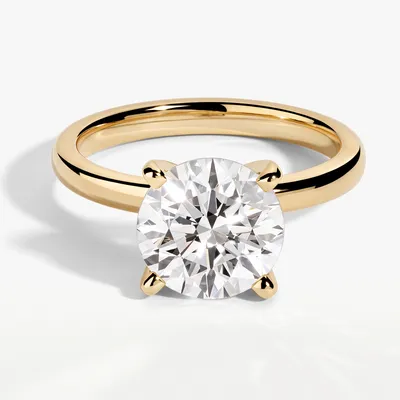
Round
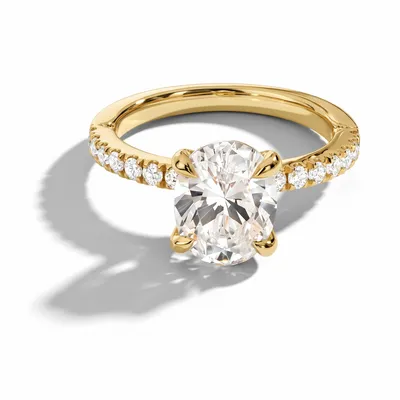
Oval
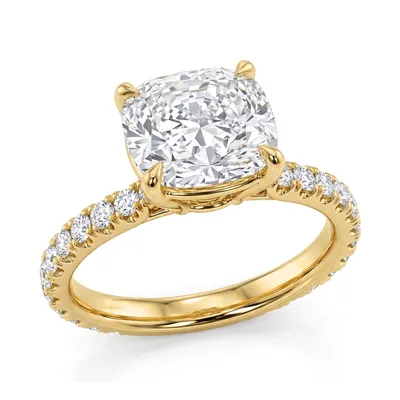
Cushion
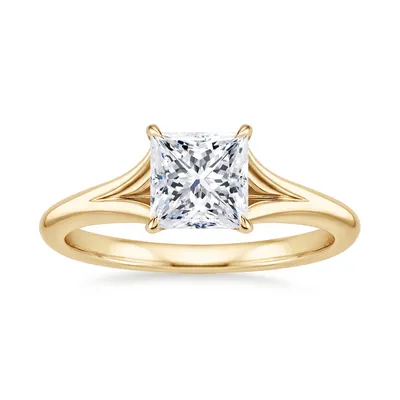
Princess
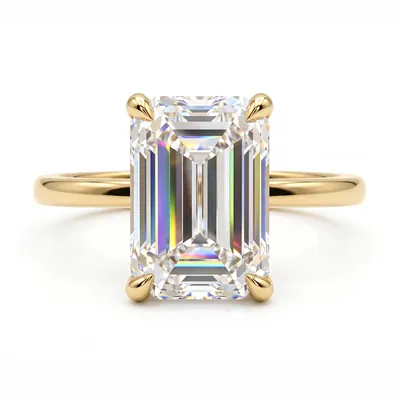
Emerald
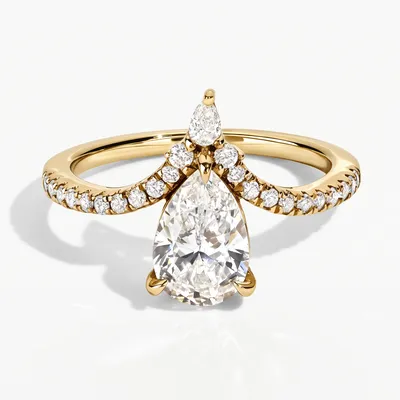
Pear
Choosing the setting
The setting is the stage the stone stands on, and it changes the whole character of the ring:
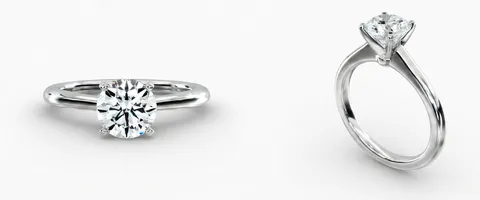
Solitaire
Classic and timeless. One stone, nothing to distract from it. When in doubt, this is the answer.
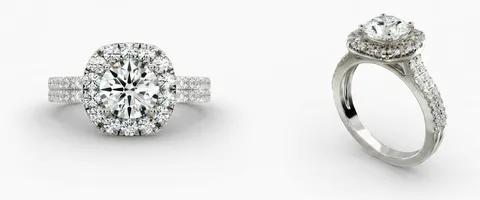
Halo
A circle of small diamonds around the center stone. Maximum glamour, and it makes the center look larger.
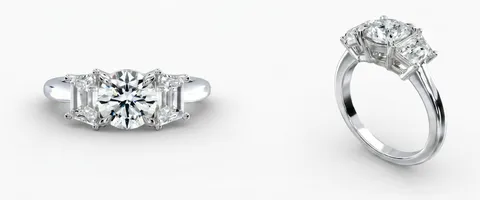
Three-stone
Past, present, and future. Romantic symbolism with serious presence on the hand.
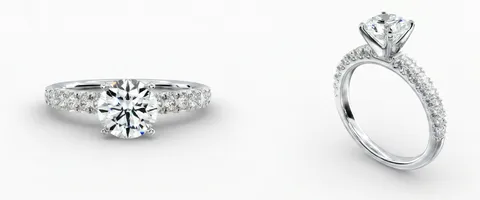
Pavé
Small diamonds down the band for continuous shimmer. Pairs with nearly every shape.
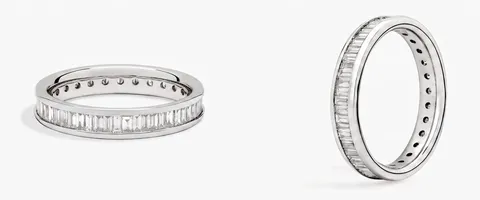
Channel-set
Stones set flush inside the band. Secure and practical for hands-on work, with a clean modern line.
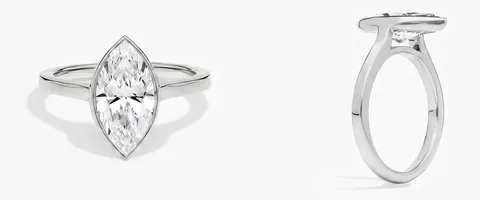
Bezel
A metal rim wraps the stone completely. Sleek and protective, with a quiet confidence.
Where to buy
You have three options: a local independent jeweler, a mall chain, or a major online retailer. Local jewelers win on service and resizing. Chains win on convenience and lose on price. The large online retailers win on selection and transparency, and they're where the 4Cs knowledge you just gained pays off hardest, because you can filter hundreds of thousands of certified stones by the exact grades you now know to target. Do this shopping in a second browser she never opens, signed out of anything you share. A week of ring searches turns into weeks of ring ads, on whatever screen she happens to pick up.
Blue Nile
A pioneer of online diamond retail, with one of the largest inventories of certified stones and search filters that map directly onto the sweet spots above. Set them to Excellent cut, G to H, VS2 or better, and watch the recipe work.
Browse Blue NileBrilliant Earth
Natural and lab-grown side by side, its responsible-sourcing pledge front and center, and a clean design-your-ring flow. Your second window for the comparison shop: same specs, two prices, take the better one.
Browse Brilliant EarthWherever you buy, insist on a GIA or IGI certificate. It's the stone's independent report card, and no reputable seller hesitates to provide it. How to read a GIA report decodes every line of it.
Finding her size without blowing the surprise
Size 6 is the most common, but do better than the average. In order of reliability:
- Borrow a ring she already wears on the same finger of the other hand, and trace the inside on paper or press it into a bar of soap. A jeweler can size from either.
- Recruit an accomplice. A sister or best friend can get her ring size in one casual shopping trip. Choose someone who can keep a secret for months, not weeks.
- When in doubt, buy half a size up. Sizing a ring down is the easier fix. A ring that won't go over the knuckle during the proposal is a story you don't want.
The full playbook, all five methods and the sizing-bead fix: how to find her ring size without her knowing.
Insure it the day you buy it
The ring is now one of the most valuable small objects you own, and it will spend the next several weeks hidden somewhere she has no reason to look (Chapter 8 covers where, and where not). Insure it the day you buy it, before it even ships. Expect 1 to 2 percent of the appraised value per year, either as a rider on your existing homeowners or renters policy or through a jewelry specialist. Keep the certificate and the appraisal somewhere safe and separate from the ring.
Decide where the box goes before you pay, too. Jewelers ship with an adult-signature requirement, and a package someone has to sign for is a package she might sign for. Have it sent to a FedEx or UPS location and held for pickup, which both carriers do for free, or ship it to work. You collect it on your schedule, and it never sits on the shared doorstep.
Questions we hear the most
How much should I spend?
Forget the three months of salary rule (Chapter 2 buries it). Spend what fits the budget you set there; the yes never depended on the carat count.
How long does the ring take to arrive?
Custom settings run four to six weeks; a stock setting buys back most of that time. Order at least two months before your date so shipping delays never touch your plan. Starting later than that? Stay with a stock setting and a stone already in inventory. You'll have fewer options, and your date holds.
Lab-grown or natural?
Chemically and visually identical, and lab stones cost far less for the same grades. This one is her call as much as yours, so listen for clues the same way you did for shape. We cover the full tradeoffs in the lab-grown versus natural breakdown in Ring School.
Which hand does the engagement ring go on?
The fourth finger of the left hand, by American custom. The old story behind it says a vein ran from that finger straight to the heart; the anatomy was wrong, but the tradition stuck. Some countries put it on the right hand instead, so if her family comes from one of them, ask a cousin before you assume.
Do you propose with the engagement ring or the wedding band?
The engagement ring. It's the one with the stone, presented at the proposal and worn from the yes onward. The wedding bands come later, exchanged at the ceremony, and after the wedding the two usually stack on the same finger with the band underneath.
The Blessing
Listen more than you speak. Their objections are often misunderstandings you can clear up.
→Set up the Ring Studio in the app.
Her size, her style notes, your shortlist, and your order deadline, tracked in one private place.
Open the Ring Studio