What the report is
The Gemological Institute of America is an independent lab. Sellers send stones in; GIA grades each one without knowing what price anyone hopes to get, then documents the result. The report is that document: the stone's grades, its exact measurements, a map of its flaws, and the number that ties it all to the lab's records. Nothing on it was written by someone trying to sell you something, which is exactly why you insist on it.
Keep it separate in your head from an appraisal. An appraisal estimates replacement value for insurance, usually from the seller's own desk, and you'll want one for the policy. On the grades themselves, the lab's word is the only one that counts. Our paperwork rule from Masterclass Part 4 holds everywhere: GIA or IGI, no substitutes.
Verify it first
Before you study a single grade, prove the paper is real and belongs to this stone. Two checks, about thirty seconds each.
Run the number. Every report carries a report number. Type it into GIA Report Check and the lab's own copy of that stone's report appears, grades and all. Compare it against the seller's listing; if they disagree anywhere, walk. Newer reports carry a QR code that opens the same lookup from your phone in the store. IGI reports verify the same way at igi.org.
Match the stone. Many GIA-graded diamonds carry the report number laser-inscribed on the girdle, the thin band around the stone's widest edge. It's far too small for the naked eye, so ask to see it under the microscope. A transparent jeweler enjoys showing it; hesitation is its own answer.
The report, line by line
Top to bottom, here's what each line says and what to do with it.
| Line | What it tells you |
|---|---|
| Report number and date | The stone's ID in GIA's records. This is the number you just ran through Report Check, and the one inscribed on the girdle. |
| Shape and cutting style | "Round brilliant," "emerald cut," and so on. Confirm it matches the listing; it happens. |
| Measurements | The stone's dimensions in millimeters. On the finger, millimeters are what she sees; two stones of equal weight can spread differently. |
| Carat weight | To the hundredth, like 1.02. The value play from Part 2 lives on this line: just under the magic sizes, 0.90 instead of 1.00, looks the same and costs meaningfully less. |
| Color grade | D (colorless) down to Z (visibly yellow). The sweet spot is G to H: icy white to every eye that isn't holding a master stone next to it. |
| Clarity grade | Eleven steps from FL (flawless) to I3 (included). VS2 and better read eye-clean almost every time, and many SI1 stones do too, though not all; the plot below tells you whether this particular stone wears its grade well. |
| Cut grade | Excellent to Poor, and only standard round brilliants get one. Fancy shapes have no cut line at all, so for them the next two lines carry the weight. |
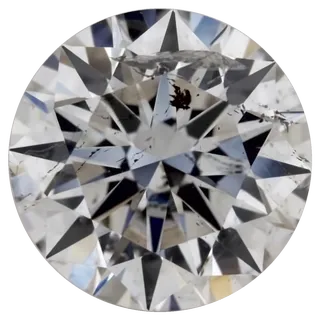 I1
I1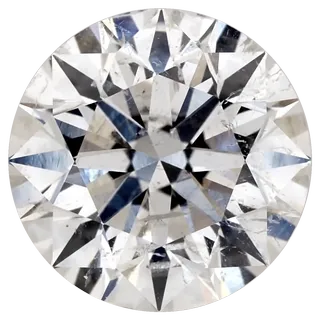 SI2
SI2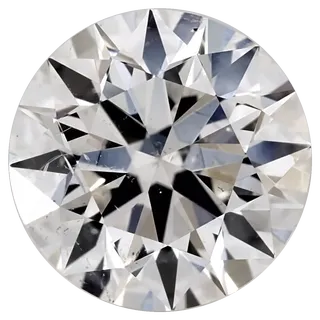 SI1
SI1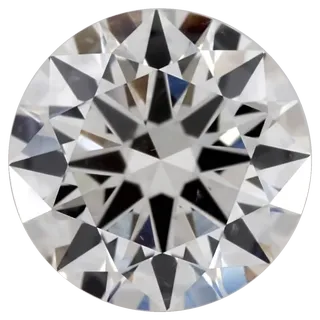 VS2
VS2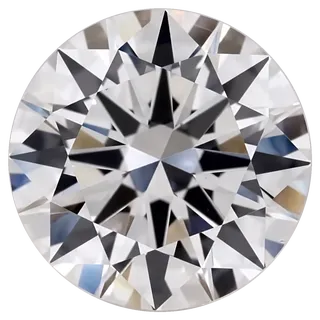 VS1
VS1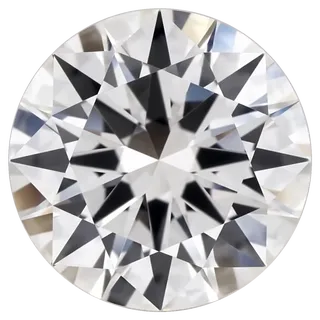 VVS2
VVS2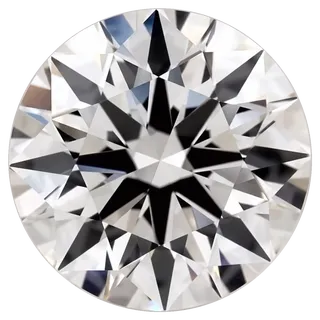 VVS1
VVS1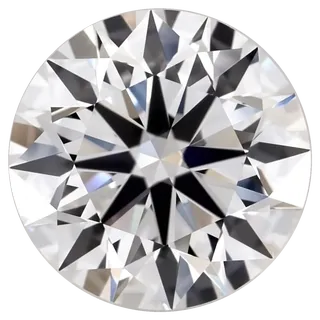 IF
IFEight of the eleven clarity steps, face up at one size. VS2, labeled in gold, is the grade to aim for. FL sits above IF, and I2 and I3 below I1, and you're unlikely to meet any of the three in a shop. What the row shows is where the money stops buying anything your eye can check: somewhere around VS2. See the full walk through the grades for what each one costs.
Polish, symmetry, fluorescence
Polish is how finely the facets were finished; symmetry is how precisely they line up. Both run Excellent to Poor. On a round with an Excellent cut grade, they're usually along for the ride. On a fancy shape they're your stand-in for the missing cut grade: hold out for Excellent on both.
Fluorescence is a description, no grade attached: None, Faint, Medium, Strong, or Very Strong, reporting how the stone glows under UV light. In daylight it almost never shows. A small minority of Strong stones can read slightly hazy in direct sun, so with Strong or Very Strong on the line, look at the stone outdoors or in the 360 video before you commit. Otherwise it's trivia.
The clarity plot
The full grading report maps every flaw the grader found onto two outline drawings of your stone, viewed from the top and from underneath. Red symbols mark inclusions, the characteristics inside the stone. Green marks blemishes on the surface. A legend underneath names each symbol: crystals, feathers, clouds, pinpoints, and the rest of the family.
The plot is the most underused part of the report, because it answers the question the clarity grade can't: where do the flaws live? A feather tucked out near the girdle disappears under a prong forever. The same feather dead center under the table is the one you'd eventually spot at brunch. Two stones can share an SI1 and wear it completely differently, and the plot is where that shows before any money moves.
It's also a fingerprint. No two stones plot alike, so a jeweler putting the diamond under the scope and finding each mark where the drawing says it should be is the deepest identity check there is.
The proportions diagram
A side-view drawing with the stone's geometry: table percentage, depth percentage, crown and pavilion angles, girdle thickness. If you've held the line on an Excellent cut round, the lab has already done this math for you and you can move on. If you enjoy checking anyway, the classic round sweet spot is a table in the mid-50s percent and a depth around 59 to 63 percent. Numbers far outside that range are how a stone hides weight in its belly instead of showing it face-up.
The three reports you'll meet
The Diamond Grading Report is the full document: available for natural stones from 0.15 carats with no upper limit, and it's the one with the clarity plot.
The Diamond Dossier is the compact version, for natural stones from 0.15 to 1.99 carats, so it covers most engagement stones. There's no plot; instead every Dossier stone gets the laser inscription, and the girdle becomes your match. It comes on paper or as a digital report behind the same Report Check lookup, and both are current.
The Laboratory-Grown Diamond Report grades lab-grown stones in the same language, with the origin printed plainly on the report and inscribed on the girdle. Whichever origin you chose in the lab-versus-natural decision, the report should say so in writing. A listing whose stone and report disagree on origin is a walk-away, no conversation needed.
Red flags
No report, or a store certificate standing in for one. An in-house "cert" is the seller grading their own homework. Politely ask for the GIA or IGI paper; if there isn't any, there are other stones.
The hidden report number. Some listings show the grades and blur or omit the number. Retailers know a number lets you find the same wholesale stone elsewhere and compare, which is precisely why you want it. Ask for it before any deposit.
A lab you've never heard of. Grading isn't regulated, and soft labs hand out flattering grades that make weak stones price like strong ones. The rule stays GIA or IGI.
No way to check the girdle. If the stone is already set so deep that nobody can find the inscription, and there's no plot to match against, you're being asked to take the pairing of paper and stone on faith. A jeweler with nothing to hide will put it under the scope for you.
Questions we hear the most
Is GIA the only lab worth trusting?
No, but GIA is the one to ask for. It wrote the grading language the trade runs on, so get a GIA report when you have the choice. An IGI report clears our paperwork rule too. Unfamiliar labs and in-house certificates don't.
Two stones have identical grades. Why is one cheaper?
Grades are bands, and stones sit at different spots inside them. The plot, the proportions, and the fluorescence line are usually where the difference hides, and sometimes it's nothing on the report at all, just one vendor's margin. Running the same grade recipe across two retailers is how you find out which.
Do I need the full report, or is the Dossier enough?
Both are real GIA reports, and a Dossier stone is fine: the laser inscription on the girdle does the matching work the plot would do. If two similar stones are in front of you and one carries the full report, take that one, because the plot shows where the flaws sit. The Dossier stops at 1.99 carats, so at two and up you get the full report anyway.
Run the number on Report Check. Match the inscription on the girdle. Confirm the listing's grades against the lab's copy. Then glance at the plot for anything sitting dead center under the table. Do those four and nobody can sell you a story.
Your shortlist keeps the receipts.
Every ring you save in the free app's Ring Studio has a field for the report number, and the compare table holds the grades side by side while you decide.
Open the Ring Studio